Wedding & Occasion Styling
How to Choose a Clutch for an Indian Wedding
Two things matter more than anything else here: how much detail your outfit already has, and whether you're the bride, in the bridal party, or a guest. Everything else — gold or silver, ornamented or plain — follows from those two.
If your outfit already carries heavy embroidery, zari work or stonework, a quieter clutch usually works better than a competing one — something like Chandrika Royale, with its fluted panels and dense floral scrollwork but no additional tassel or hanging embellishment, sits alongside a busy outfit without adding to the noise.
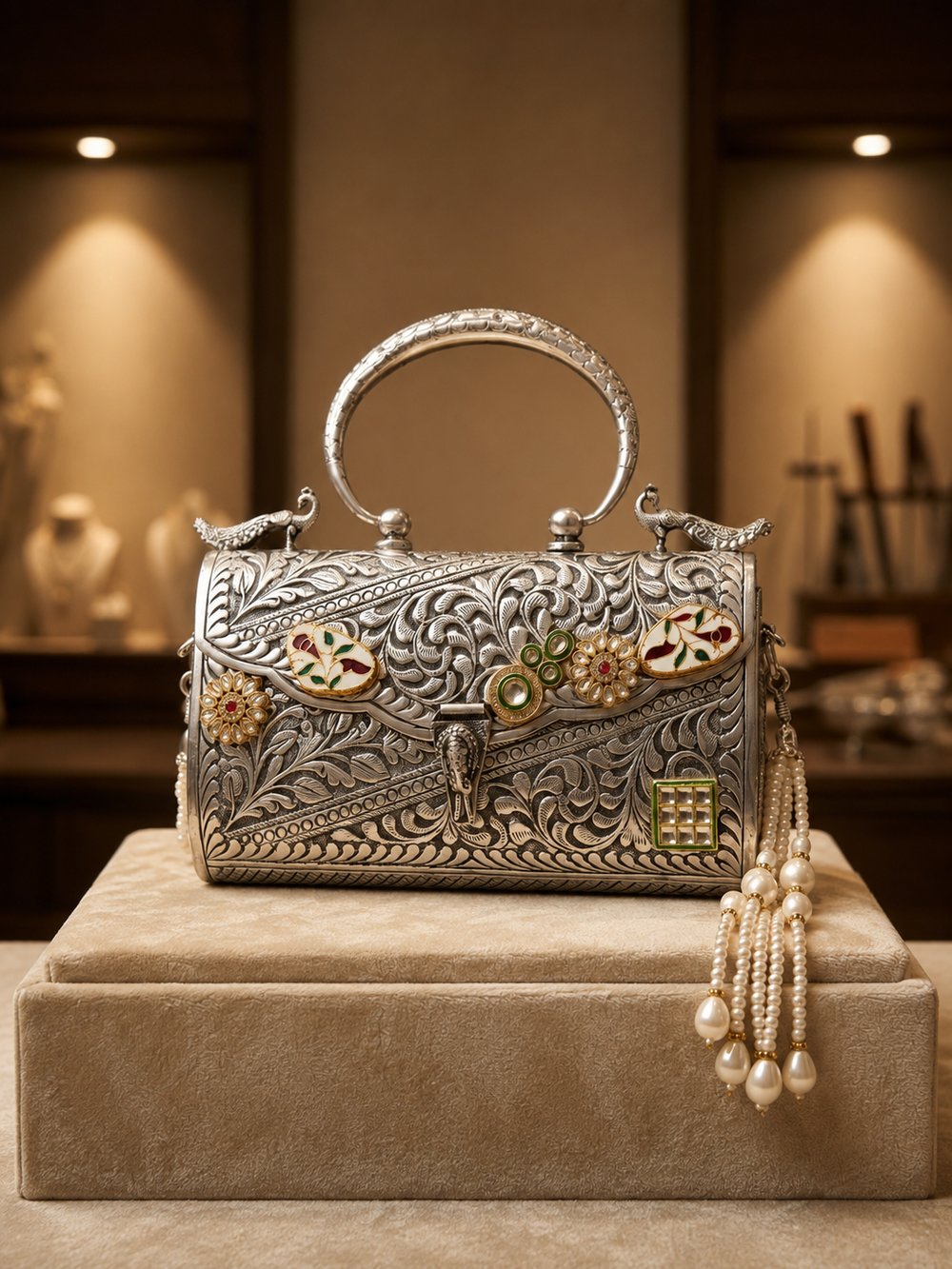
If your outfit is simpler — a plainer silk saree, a lehenga in a solid or lightly worked fabric — the clutch has more room to be the detail. Pearl Maharani's meenakari inlay and cascading pearl tassel, or Noor-e-Raj's kundan-style stonework set into an elephant-head handle, both work as the outfit's main point of interest rather than a supporting one.
One approach some brides take is to reach for the more ornamented pieces in the range, since the rest of a bridal look is often already built to carry that level of detail. Svarangana Royale — Platero's signature piece, an antique gold-finish oval frame hand-engraved with a full scene and finished with pearl chain drops — is one option worth considering along those lines.
For guests, a quieter but still festive piece is one approach if you'd rather not draw attention away from the bride's own styling. Kanak Royale — antique gold, edge-to-edge scrollwork, beaded fringe — is an example of that kind of choice, though this is a matter of personal preference rather than a fixed guideline.
There's no fixed rule here. One reference point some people use is the jewellery or other metal details already in their outfit — a gold-finish clutch alongside gold jewellery, or a silver-tone piece alongside silver, is one straightforward way to coordinate, though exact matching isn't required. Because these are hand-engraved metal rather than printed fabric, the piece reads closer to jewellery than to an accessory that has to coordinate precisely with a print or colour.
The same logic applies to both. A saree, especially one worn with a free hand for draping, tends to suit a compact clutch you can hold in one hand without thinking about it — Noor-e-Raj's barrel shape and fixed ring handle work well here. A lehenga, particularly a heavily worked one, can carry a more ornamented piece like Pearl Maharani without looking overdone, since the clutch is competing with less exposed embroidery at hand height than a saree blouse or pallu often has.
These are rigid metal frames, not expandable soft bags, so they offer less flexibility in what they can hold compared with a soft clutch. It's worth thinking about what you'd normally carry for an evening out and whether a fixed, compact interior suits that — if you typically carry more than the essentials, using a larger bag to travel to the event and a smaller piece like this once you're there is one common approach.
See the full edit of clutches built for weddings and celebrations, from quietly festive to fully ornamented.
Browse Wedding Clutches